
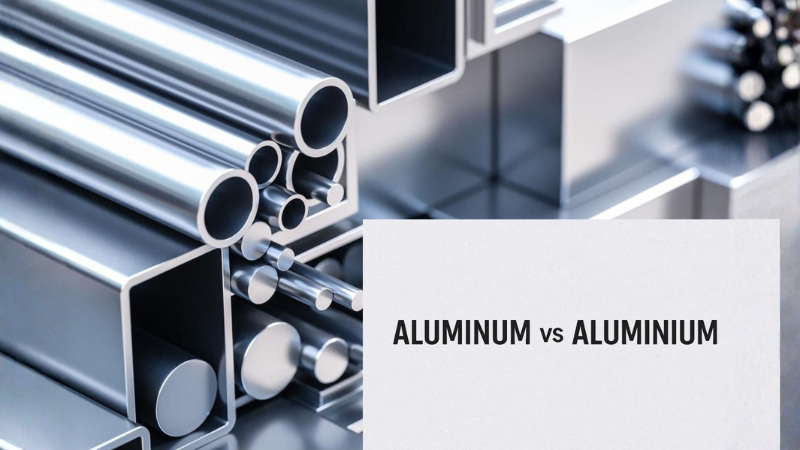
Any business dealing with metal manufacturing has to address aluminum components on a daily basis. Surprisingly, the first confusion regarding aluminum comes from the spelling rather than the specs or uses.
You’ll find countless documents and sources called it either “aluminium” or “aluminum”. It seems like a minor difference or mistake, with an extra syllable or a missing letter.
However, the spelling alternative comes from a history related to scientific discovery, cultural influence, and linguistic evolution. Explore the correct use of the two spellings to avoid confusion with clients.
Spelling History of Aluminum and Aluminium
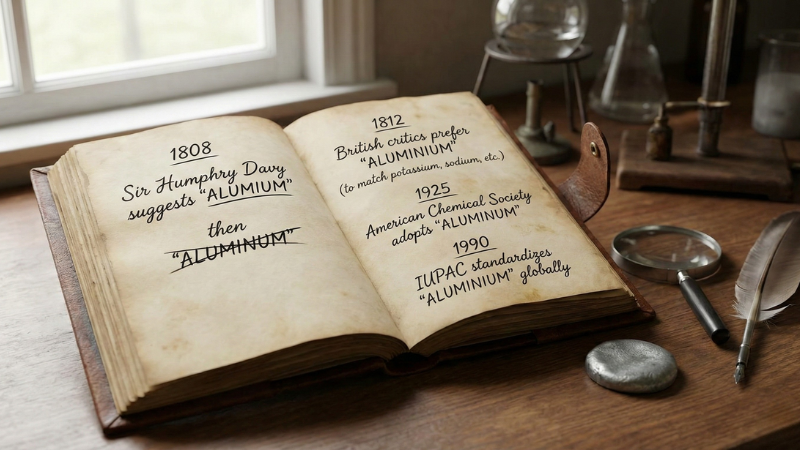
The story of the word aluminum marks the evolution from mineral names to modern standards. And the term itself got shaped by chemists, lexicographers, and scientific bodies across regions.
Early Name: Sticking to Alum and Alumina
Alum (a sulfate group for dyeing and tanning) predates the metal’s isolation. The highly active metal was actually found in the Earth’s crust as bauxite.
It also provided the linguistic root for later names. Inorganic chemistry continued to mature, and alumina was adopted to describe aluminum oxide.
It’s the material from which the raw element gets isolated/extracted. And “aluminum” and “aluminium” both emerged from the base in the early 19th century.
Sir Humphry Davy’s Science-Oriented Attempts

British chemist Sir Humphry Davy proposed a rather classical naming norm + contemporary English styling in the early 19th century. His iterations directly contributed to the dual track that later solidified regionally.
He proposed the name “alumium” first and “aluminum” later. The latter also linked the element’s name to alum/alumina while testing forms (terminology versions) that would balance scientific tradition with readability.
Introduction of ‘Aluminium’ as a Periodic Table Classic
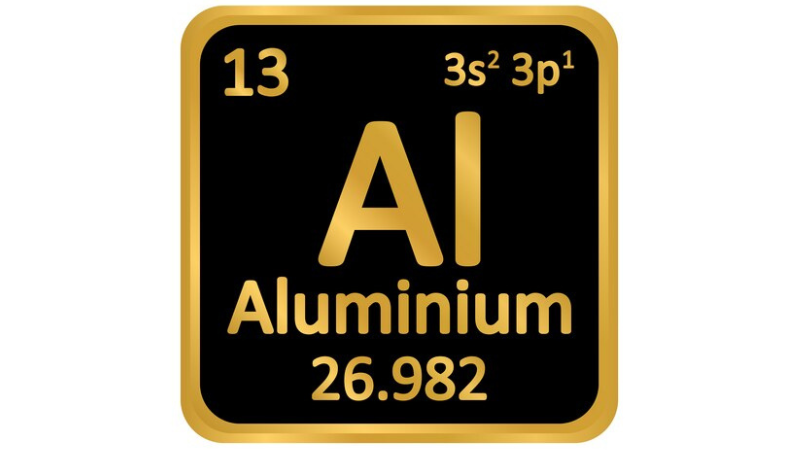
Aluminium aligns with the heavily used “-ium” suffix in the periodic table (sodium, calcium). The name aluminum reinforces a classical sound and consistency in Commonwealth conventions.
It became the standard across Europe and European colonies, just like new metal names at that time. It emphasized continuity with other element names in academic and technical publishing.
Webster Dictionary and the American Chemical Society (ACS)
American lexicographic tradition looks into simplified spelling. More specifically, Noah Webster heavily influenced Americanized spellings. And it eventually resulted in the name “aluminum” in the USA.
The American Chemical Society (ACS) acknowledged it by adopting “aluminum” as the official US spelling in 1925. It also cemented a national standard across industry, academia, and consumer contexts.
IUPAC’s Official Recognition of ‘Aluminium’
International scientific styles and global conventions commonly stick to the “-ium” family alignment. That’s why you’ll find “aluminium” more frequently in many international contexts.
From a practical standpoint, it means international publications and standards present “aluminium”. However, US documents still maintain aluminum, which is understood and accepted in scientific discourse.
You may contact/brief international buyers, including investors from the US. In that case, adopt a style rule such as “consistent regional spelling”; don’t mix the name aluminium with the other.
Regional Preferences: Aluminum or Aluminium
Conducting trustworthy and reliable business means knowing where to put each spelling as standard. It can localize products, compounds, and content of the chemical element without confusing the clients.
Aluminum for North American Clients
“Aluminum” is the dominant spelling in dictionaries, academic publishing, industry standards, and consumer products throughout the US and Canada. “Aluminum foil”, “aluminum siding”, and “aluminum alloy 6061” widely make it to retail labeling, engineering catalogs, and university materials.
US and Canadian clients overwhelmingly expect “aluminum” on packaging to wrap food/beverage cans + e-commerce listings. Such a simple but localized spelling makes it a trust signal in products, manuals, and ads. Grocery products and cooking guides in North America invariably use “aluminum foil”.
Aluminium: UK and Other English-Speaking Regions
The UK, EU, Australia, New Zealand, and many Commonwealth countries still implement “aluminium”. The form appears in textbooks, standards, and consumer contexts. Everyday references include “aluminium foil”, “aluminium frames”, “aluminium extrusions”.
Outside North America, English sources predominantly standardize on “aluminium”. The classical suffix pattern maintains familiarity in engineering, industrial, and retail content. However, many businesses in the commonwealth regions are switching to simpler “aluminum”.
Practical Recommendations for Using the Terms
Consider using “aluminum” for the US/Canada and “aluminium” for the UK/EU/Commonwealth. It should help clients match search behavior, improve credibility, and reduce returns or confusion.
However, pick one spelling per asset (product page, datasheet, lesson, or post) and stick with it. Your business may serve multiple regions; put a style note in the documents to clarify the equivalence.
Create region-specific documents with naturally included “aluminum” or “aluminium”. Put it before the contextual phrases (foil, extrusions, and alloy grades like 6061/7075) used in each market.
For example –
- North America: “Aluminum Alloy 6061: Properties, Machining, and Heat Treatment” (spec sheet).
- UK/EU: “Aluminium Alloy 6061: Properties, Machining, and Heat Treatment” (standard references).
Both represent the same technical content while meeting regional expectations. No technical/chemical differences are in existence between aluminum and aluminium (the same atomic number, 13).
FAQ·
What is the difference between aluminium and aluminum?
Both refer to the same metallic element. The only difference lies in spelling. The US and Canada use “aluminum” whereas “aluminium” is the standard in the UK, EU, and Commonwealth countries.
Which is correct: aluminium or aluminum?
Both terms are regionally correct. Aluminum is the correct one in American English. Meanwhile, aluminium is the correct British word across the UK and most of the English-speaking world.
Why are there two spellings for the same element?
The split originates from the early 19th-century naming. British scientists stick to “aluminium” like other “-ium” metals. American dictionaries and the American Chemical Society adopted “aluminum”.
Is aluminium older than aluminum?
Surprisingly, yes. Alumium first evolved to aluminum in the early 1800s. However, aluminium became the international form because it matched the preferred pronunciation of the periodic table elements.
Why does the US use aluminum instead of aluminium?
Noah Webster’s dictionary favored simplified spelling. Fees for US newspaper ads were determined by the number of letters. Most importantly, ACS officially adopted “aluminum” in 1925.
Which spelling does IUPAC recognize?
The International Union of Pure and Applied Chemistry (IUPAC) recognizes “aluminium” as the official spelling. It draws a clear line from the American English, though “aluminum” receives more emphasis.
How should businesses choose between aluminium and aluminum?
Implement the spelling that matches the target market. For example, US product listings should say “aluminum foil”. Conversely, any listings within Great Britain should say “aluminium foil”.
Conclusion
Whether to use aluminium and aluminum is like a spelling quirk. However, the distinction blends history, science, and culture. You say aluminium to UK traders or aluminum to clients from New York. Nonetheless, you’re still talking about the same metal from industrial manufacturing perspectives.
Top-Quality Aluminum (Aluminium) Components for Your Needs at HONJENNY
Honjenny guarantees precision, efficiency, and usability for high-quality aluminum components. We’ve been in the business for 30+ years with commitment. Contact us to reach our experienced experts.