
When designing metal components for high-volume manufacturing, selecting the right material is a critical engineering decision. The choice between zinc vs aluminium directly impacts part weight, tooling longevity, thermal dynamics, and overall production costs.
Engineers frequently face a balancing act: minimizing component mass for efficiency while simultaneously seeking to extend mold life to reduce unit costs. Understanding the metallurgical realities of zinc and aluminum is essential for specifying the correct alloy and ensuring structural integrity.
Zinc vs Aluminium In Die Casting
At its core, the difference between zinc alloy vs aluminum centers on melting temperatures and density. Aluminum offers a superior strength-to-weight ratio and high thermal tolerance, making it a staple in automotive and aerospace applications.
Zinc, conversely, provides exceptional castability, longer tooling life, and superior room-temperature impact strength, favored heavily in telecommunications and consumer electronics.
The primary decision goal for any die casting project is to match the mechanical requirements of the specific application to the most cost-effective manufacturing process.
Die Casting Process Comparison
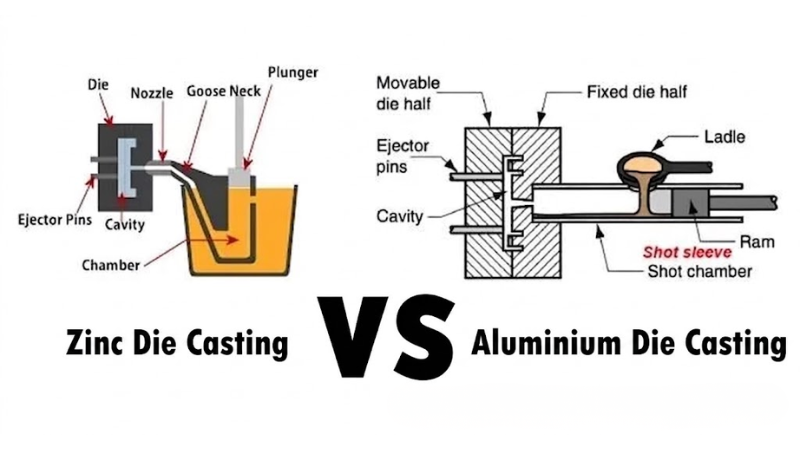
The melting point of the chosen alloy dictates the casting machinery required, which subsequently drives cycle times and tooling amortization.
- Hot-Chamber Process (Zinc): Zinc alloys melt at lower temperatures (~380°C to 420°C). This allows the injection mechanism to be submerged directly in the molten metal bath. The process yields extremely fast cycle times and minimal thermal shock to the mold steel.
- Cold-Chamber Process (Aluminum): Aluminum requires higher temperatures (~650°C), which would degrade submerged injection components. Molten aluminum is ladled into a cold chamber before injection. This process has a slower cycle time compared to zinc.
- Tooling Life: The thermal fatigue in cold-chamber aluminum casting typically limits mold lifespan to 100,000–150,000 shots. Zinc hot-chamber molds regularly exceed 1,000,000 shots due to the lower operating temperatures.
Material Properties: Aluminum And Zinc
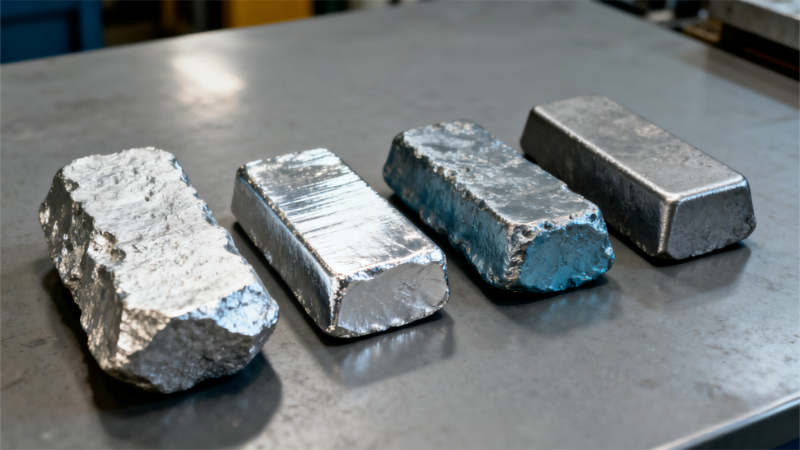
Evaluating the physical properties of zinc die casting components versus aluminum parts requires a direct comparison of density and conductivity.
- Density and Weight: Aluminum is exceptionally light (~2.7 g/cm³), making it ideal for weight-sensitive designs. Zinc is significantly denser (~6.6 g/cm³), resulting in parts that are roughly 2.5 times heavier than their aluminum counterparts.
- Thermal Tolerance: Aluminum maintains structural stability at elevated operating temperatures. Zinc components are subject to creep and loss of tensile strength in environments continuously exceeding 100°C.
- Conductivity: A380 is a standard aluminum alloy offering excellent electrical conductivity and heat dissipation, frequently used for heat sinks. Zamak (zinc alloys) also provides good thermal conductivity but is generally surpassed by aluminum in high-performance electronics cooling.
Corrosion Resistance And Surface Finishing

Both alloys naturally form protective oxide layers, but secondary surface finishes are often required for functional or aesthetic purposes in industrial environments.
- Aluminum die castings are highly receptive to anodizing, powder coating, and chemical film (chromate) conversions, which provide robust protection against harsh environmental exposure.
- Zinc parts are typically finished via electroplating (such as nickel, chrome, or copper) and chromate passivation, providing both corrosion resistance and a premium cosmetic appearance.
Mechanical Performance And Dimensional Stability
21-1024x576.jpg)
When assessing dynamic load capabilities, both alloys present distinct engineering profiles. In room-temperature environments, zinc offers superior ductility and shock absorption.
Tolerances: Both materials support tight as-cast geometries, though zinc inherently holds tighter net-shape dimensions due to its lower casting temperature and minimal shrinkage. Standard linear tolerances for zinc typically sit around ±0.025mm (per initial 25mm), while aluminum averages ±0.05mm.
Regardless of the chosen alloy, critical mating surfaces or fluid-tight seals will always require secondary CNC machining to achieve extreme micron-level precision (down to ±0.005mm).
Zinc (e.g., Zamak 3): Offers a yield strength of 220–250 MPa with exceptional elongation (7%–10%). Its room-temperature impact resistance (~58 J) far exceeds aluminum, making it ideal for vibration dampening.
Aluminum (e.g., A380): Delivers a high strength-to-weight ratio with tensile strengths reaching 310–320 MPa. However, elongation is low (2.5%–3.5%) and impact strength is poor (~4 J), making it relatively brittle under sudden physical shock.
Lesser Residual Stress In Zinc Die Casting
The high fluidity and lower casting pressures associated with zinc die casting result in components with significantly lower residual stress compared to aluminum. This is a critical advantage when manufacturing intricate, multi-part assemblies where post-casting warpage or dimensional shifting cannot be tolerated.
Quick Comparison Table: Aluminum vs Zinc
The table below outlines the general mechanical and process comparisons between standard zinc and aluminum alloys.
When To Choose Zinc Die Casting
Specify zinc alloys for your manufacturing project when your design requires the following capabilities:
- Ultra-thin wall geometries, reliably cast down to 0.5mm.
- High-volume production runs where tooling lifespan must exceed 1,000,000 shots.
- Applications demanding superior room-temperature impact resistance and ductility.
- Components requiring premium cosmetic electroplating or high-quality as-cast finishes.
When To Choose Aluminum Die Casting
Specify aluminum alloys for your project when evaluating the following application constraints:
- Large structural components where minimizing assembly weight is the primary metric.
- Engine blocks or mechanical housings operating continuously above 100°C.
- Enclosures and heatsinks requiring maximum thermal and electrical conductivity.
- Projects requiring high specific strength (strength-to-weight ratio).
Design Considerations For Your Die Casting Project
Optimizing a component for manufacturability requires aligning wall thickness with the selected alloy. Zinc accommodates extreme intricacies, while aluminum typically requires minimum walls of 1.0mm to 1.5mm to prevent incomplete fills and gas porosity.
Specify your exact precision tolerances and surface finishes during the CAD phase. Requesting an early Design for Manufacturability (DfM) review ensures the chosen alloy grade perfectly matches your functional constraints.
FAQs
Is zinc die cast strong?
Yes. At room temperature, zinc die-cast alloys (such as Zamak 3) exhibit excellent tensile strength and superior impact resistance, often outperforming cast aluminum. However, zinc is susceptible to creep and loses its mechanical strength in continuous operating environments exceeding 100°C.
Is zinc better than aluminum?
Neither is universally better; it depends entirely on your application constraints. Zinc offers superior castability, extreme tooling longevity, and high room-temperature toughness. Aluminum provides a much higher strength-to-weight ratio and maintains dimensional stability at elevated temperatures.
Which is cheaper, aluminum or zinc?
Aluminum raw material is typically cheaper by weight. However, zinc’s lower melting point reduces energy consumption and extends mold life to over one million shots. For very high-volume production runs, zinc often delivers a lower overall unit cost due to reduced tooling amortization.
What two metals should not be used together?
In mechanical assemblies, avoid pairing metals with widely differing anodic indices in damp environments, such as aluminum and copper, or zinc and bare steel. This mismatch triggers galvanic corrosion. Always specify appropriate surface plating or isolating gaskets to prevent the less noble metal from degrading.
Conclusion
Selecting the correct material between zinc and aluminum is fundamental to the functional and economic success of your die-cast assembly. Aluminum remains the industry standard for lightweighting initiatives, high-temperature stability, and high-strength structural applications.
Conversely, zinc excels in projects requiring ultra-thin walls, superior room-temperature impact resistance, and maximum tooling longevity. By carefully mapping your mechanical load requirements to the inherent properties of each alloy, engineers can optimize both structural performance and overall unit cost.
Discuss Your Die Casting Project
Need help choosing the right alloy and die casting process for your metal parts? Honjenny can support you with material selection, process recommendations, and production solutions based on your actual application. Contact Honjenny today to start your inquiry and get technical support.