
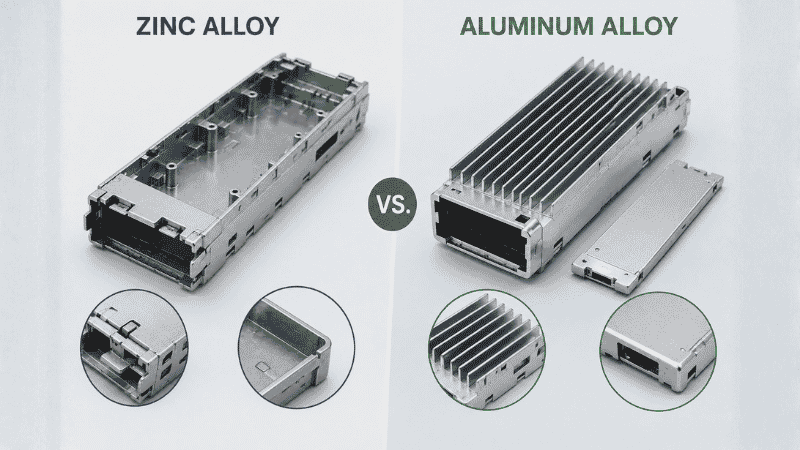
Choosing between zinc and aluminum for optical transceiver housings is not simply a choice between better precision and better cooling. The right material depends on the housing geometry, module power, weight limit, finish, tolerance, and annual volume. We have seen an aluminum SFP+ housing struggle with incomplete latches even though aluminum looked like the cheaper choice on paper. After changing it to zinc, the customer accepted a small increase in weight and temperature in return for much better yield and lower total cost. This guide explains when each material works best and how to make the choice before tooling begins.
Zinc vs. Aluminum: The Quick Answer
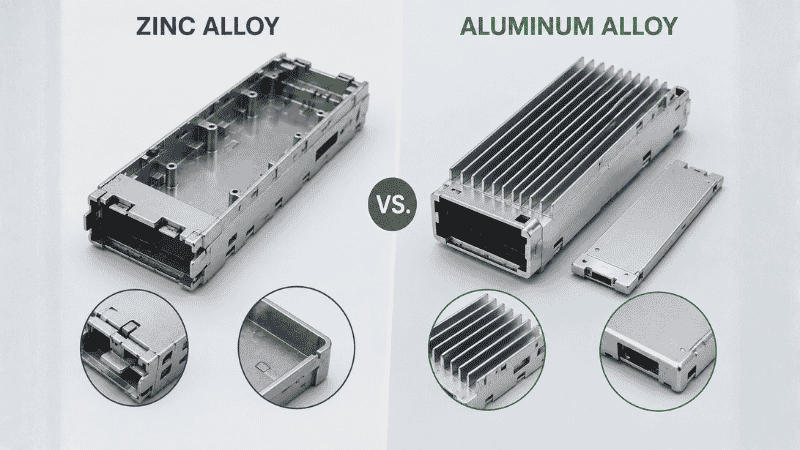
Choose zinc when the housing has very thin walls, fine latches, narrow shielding slots, tight local fits, or an electroplated finish. Zinc fills small details well and can reduce the need to machine features after casting.
Choose aluminum when low weight and heat removal are the main limits, especially for a larger base with integrated cooling fins. Aluminum is often the stronger candidate for higher-power modules, provided the wall and latch design can be cast reliably.
These are starting points, not fixed rules. A QSFP-DD label does not automatically require aluminum, and an SFP label does not automatically require zinc. The material decision should follow the actual part design and verified thermal requirement.
Zinc vs. Aluminum: Key Differences at a Glance
The table below focuses on the differences that matter during product development rather than listing every material property.
Weight and Thermal Performance
Aluminum is much lighter by volume. Aluminum Association product data reports a typical density range of 2.66 to 2.84 g/cm³, while the International Zinc Association lists ZP3 at 6.66 g/cm³ in its material comparison data. This puts aluminum at roughly 40% of the density of ZAMAK 3 before geometry changes are considered.
The finished part will not always follow this theoretical difference because the materials may need different wall, rib, and fin designs. Our QSFP-DD project achieved a measured 42% weight reduction against the corresponding zinc concept.
Aluminum also offers a better basis for demanding heat-sink designs. But thermal performance cannot be decided from a material table alone. Fin area, wall thickness, contact flatness, interface material, airflow, and internal heat paths all affect the final temperature.
Thin Walls and Fine Features
Zinc becomes attractive when the housing is small but geometrically busy. The International Zinc Association design guide notes that sub-0.5 mm sections can be practical over short flow distances, although achievable thickness increases as the distance from the gate grows.
This does not mean every zinc housing should use a 0.5 mm wall. It means zinc offers more design room for thin walls and small details when the gate and geometry are suitable.
Precision and Surface Finishing
Zinc often gives better repeatability on compact features, but one tolerance should not be promised for the whole part. A local latch fit and a long open sidewall behave differently during cooling.
Zinc is also a practical substrate for electroplating. The International Zinc Association lists nickel and chromium among common finishes in its polishing and plating guidance. Aluminum may be a better fit for conversion coatings and other finishes selected for grounding, corrosion protection, or appearance.
Neither material guarantees a particular EMI result. Shielding depends on the complete assembly, including seams, openings, coatings, grounding paths, and contact pressure.
When Should You Choose Zinc?
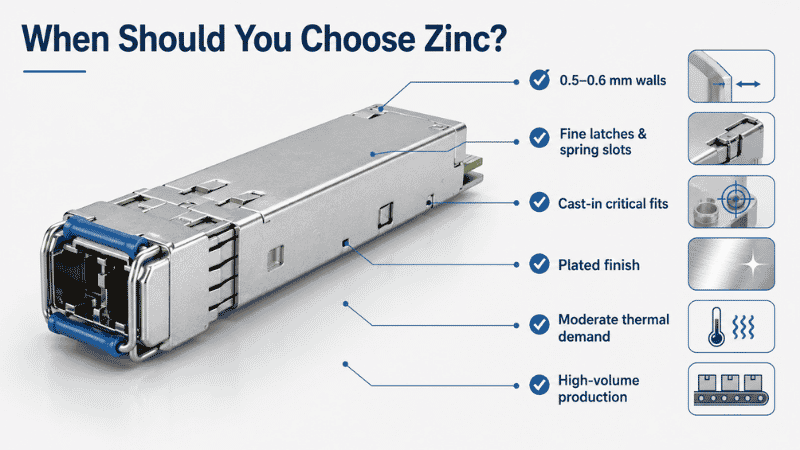
Zinc is usually the stronger candidate when several of the following conditions appear together:
- Walls approach 0.5 to 0.6 mm.
- The housing contains multiple small latches or shielding spring slots.
- Critical fits should be cast without extra CNC correction.
- The product requires nickel, chrome, nickel-gold, or another plated finish.
- Thermal demand is moderate and has been verified through testing.
- Production volume is high enough to benefit from stable hot-chamber casting.
Factory Example: ZAMAK 3 for a QSFP28 Cover
One QSFP28 100G upper cover had a minimum wall of 0.5 mm, six precision latches, and several shielding slots. The drawing also required a nickel-gold plated finish and a ±0.02 mm tolerance on selected mating features. Annual demand was about 160,000 pieces.
The module had moderate power and no extreme thermal target. We recommended ZAMAK 3 because the thin walls and fine features could be formed together, while the plating requirement suited the material.
The ±0.02 mm value was a local, project-specific tolerance, not a general tolerance for the entire casting. Tool design, process control, and inspection were built around those selected features.
In production, plating appearance yield reached 99.1%, the controlled assembly dimensions recorded no out-of-tolerance parts, and overall yield reached 98.3%. Here, zinc’s extra weight was a reasonable trade for stable detail and fit.
When Should You Choose Aluminum?
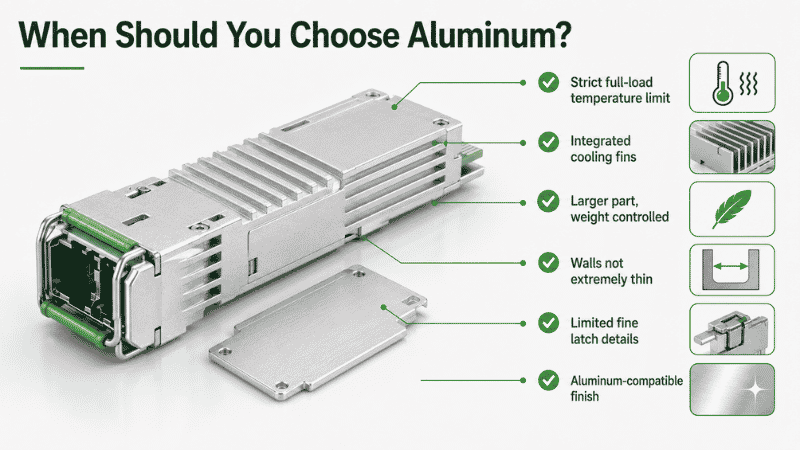
Aluminum becomes more suitable when the housing works as part of the cooling system rather than only as a protective shell. Typical signs include:
- The module has a strict full-load temperature limit.
- The base includes integrated cooling fins.
- The part is larger and weight is tightly controlled.
- Walls are not extremely thin and fine latch details are limited.
- Conductive conversion coating or another aluminum-compatible finish is specified.
Factory Example: ADC12 for a QSFP-DD Base
A QSFP-DD 400G base had integrated cooling fins, a 1.2 mm main wall, and a local maximum thickness of 5 mm. The customer required a full-load temperature rise no higher than 35°C and was sensitive to total module weight.
The finish was a conductive conversion coating, selected local tolerances were ±0.05 mm, and forecast annual demand was 90,000 pieces. We recommended ADC12 because the larger finned structure made heat transfer and weight more important than ultra-thin latch filling.
The finished aluminum design was 42% lighter than the corresponding zinc concept. It met the customer’s full-load thermal limit, and mass-production yield reached 96.4%.
This does not mean every QSFP-DD housing should use aluminum. It was better here because the base combined high thermal demand, integrated fins, larger size, and a strict weight target.
Why Lower Material Price Does Not Mean Lower Part Cost
Material price is only one line in the cost calculation. Tool complexity, cycle time, casting yield, trimming, deburring, CNC machining, finishing, inspection, and assembly rework can easily change the result.
Factory Case: Changing an SFP+ Housing From ADC12 to ZAMAK 3
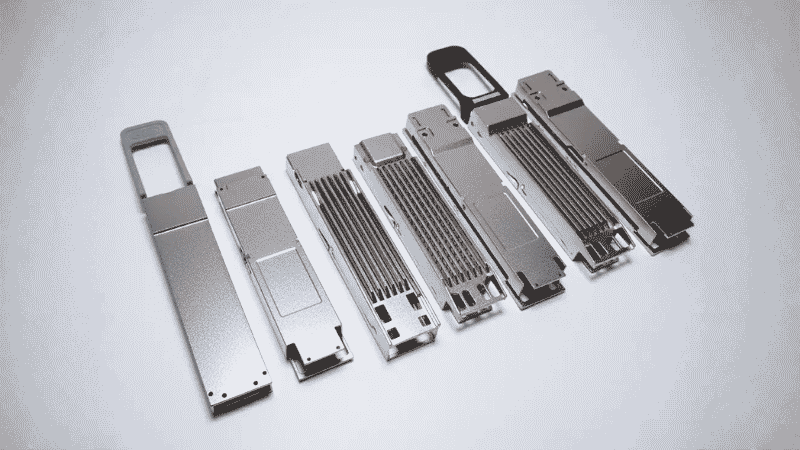
A customer selected ADC12 for an SFP+ 10G module. Aluminum offered better thermal performance, the raw material price appeared lower, and earlier large equipment enclosures had been lighter in aluminum.
However, this product was different from those larger housings. Its minimum wall was 0.6 mm, and each side included three sets of fine latches and shielding spring slots.
During the first trial, the aluminum did not fill the latch regions consistently. Dimensional variation also made some covers loose and others impossible to close. Initial yield was only 57%, and the harder aluminum flash required about twice the deburring time of the later zinc process.
We recommended ZAMAK 3 because its filling behavior suited the thin walls and fine features. The latch dimensions could also be controlled without adding CNC operations solely to correct the fit.
After the switch, the individual shell was about 7% heavier, but it remained within the customer’s weight specification. At full load, operating temperature was only 1.8°C higher than with the aluminum shell and still passed the thermal requirement.
Latch forming passed at 100%, engagement force became stable, and overall production yield rose from 57% to 97.2%. Once scrap and processing were included, total unit cost fell by 11%.
Zinc did not win on price per kilogram. It won by producing the geometry consistently, reducing deburring, avoiding corrective machining, and lowering scrap.
How Do You Choose the Right Material?
Use these six questions before freezing the drawing.
1. Is Heat the Main Limitation?
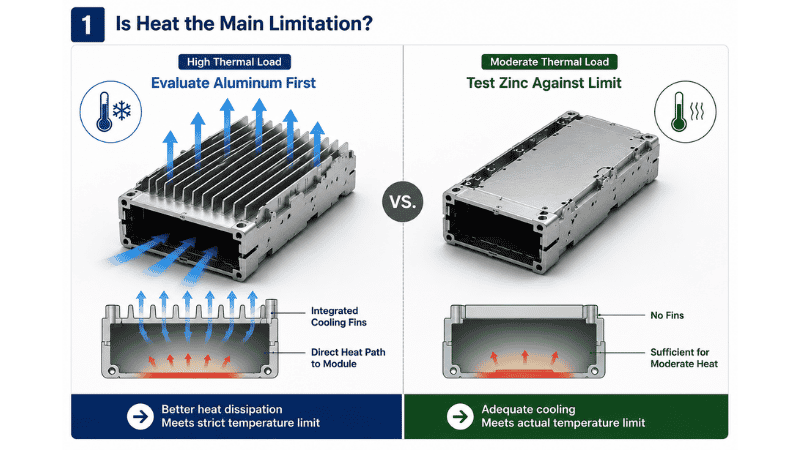
If the base directly removes heat from a high-power module and includes fins, evaluate aluminum first. If the thermal load is moderate, test whether zinc already meets the actual temperature limit.
2. What Is the Maximum Finished Weight?
Define the permitted part or module weight. Do not reject zinc only because of density if a thin-wall zinc design still meets the finished-weight target.
3. How Thin and Detailed Is the Housing?
Count the thin walls, latches, grooves, small posts, and shielding slots. The more fine features the part combines, the more likely zinc deserves serious consideration.
4. Which Dimensions Control Assembly?
Identify the latch fit, PCB location, cover gap, cage contact, and grounding surfaces. Then decide whether each feature can be cast reliably or needs machining.
5. What Finish Does the Product Need?
Include coating type, thickness, masking, and electrical contact areas in the material decision. A suitable base material with the wrong finish plan can still create fit or grounding problems.
6. What Is the Total Cost at Production Volume?
Compare tooling, cycle time, yield, deburring, machining, finishing, and inspection at the forecast annual volume. A cheaper alloy can produce a more expensive finished housing if it adds scrap and secondary work.
What Should You Send for Material Review?
Provide more than a part weight and target price. A useful review package includes:
- 3D CAD and a dimensioned 2D drawing.
- Transceiver format and applicable specification revision.
- Module power and maximum permitted temperature rise.
- Finished weight limit.
- Minimum wall and fine latch or slot details.
- Critical datums and assembly tolerances.
- Finish, masking, grounding, and EMI requirements.
- Prototype quantity and expected annual demand.
Mark which dimensions are fixed by the interface and which may change. This allows the supplier to compare zinc and aluminum without altering the product’s required fit.
Conclusion
Zinc is often the better choice for thin walls, fine latches, narrow slots, plated surfaces, and tightly controlled small features. Aluminum is often better when a larger housing must stay light and remove more heat through an integrated base or fin structure.
The right choice is the material that passes the complete design, thermal, assembly, and cost review. Comparing density or raw material price alone can hide the much larger effects of yield, deburring, machining, finishing, and scrap.
Get Material and DFM Support for Your Housing
Honjenny provides zinc die casting, aluminum die casting, in-house tooling, CNC machining, surface finishing, and dimensional inspection for custom optical transceiver housings. Send us your CAD files, module power, weight limit, finish, and expected volume to request a material comparison, DFM review, and quotation.