
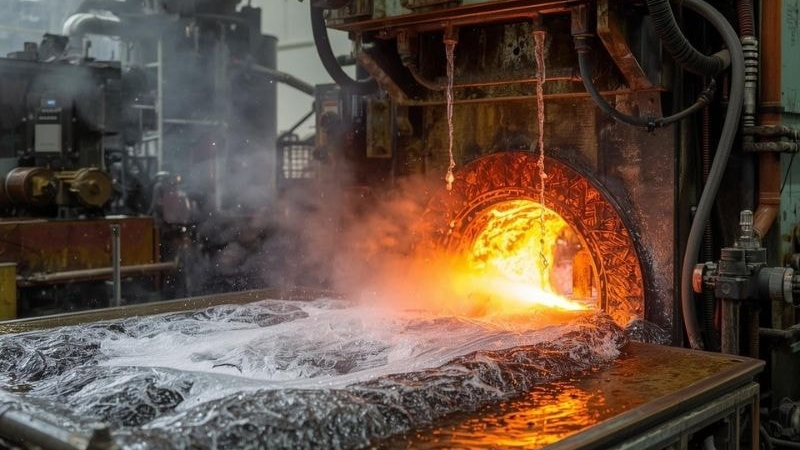
Aluminum is light, it does not corrode, and it can be shaped easily. Nevertheless, raw aluminum is commonly too soft to be used in heavy-duty or high-stress applications. That is why it is significant to heat treat aluminum. This article defines the meaning of aluminum heat treatment, its necessity, the aluminum alloys that can be heat-treated, and the principal processes.
What is Aluminum Heat Treatment
Aluminum heat treatment is defined as the process of altering the microstructure of aluminum alloys to achieve specific mechanical properties such as strength, hardness, ductility, and fatigue resistance.
A process that alters the properties of aluminum metal by heating is called aluminum heat treatment. The aluminum is heated up to a certain level.It is held at a target temperature for a set time (soak time). Based on what microstructural transformation is required, aluminum may be rapidly quenched or slowly cooled.
The chemical composition of aluminum is not altered throughout heat treatment. The process does not alter aluminum’s full shape or size. However, dimensional distortion can occur if temperatures and cooling rates are not properly controlled.
The heat-treated aluminum may be either harder, more flexible, or stronger. It is also able to withstand wear and fatigue. This and its aptitude for both light and heavy industries make it appropriate.
As an example, experiments on 6061 aluminum heating demonstrate significant strength gains when treated to the T6 condition compared to its annealed state.
Why is heat treatment necessary for aluminum?
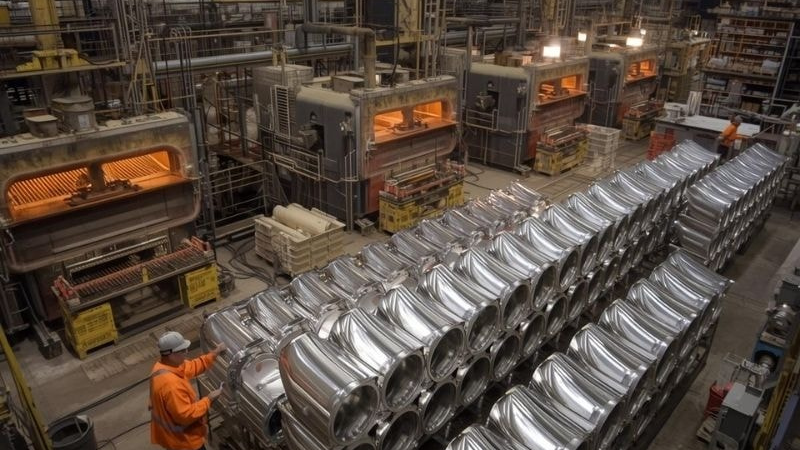
Raw aluminum is not always strong enough to support new, challenging applications. Aluminum in its raw state is soft. It can deform under pressure. It is prone to cracking or faster wearing. These issues are resolved with the help of heat treatment.
Strength and hardness are enhanced by heating. It improves wear resistance. It also improves fatigue life, which helps parts last longer under cyclic loads.This implies the aluminum has a longer life cycle when it is exposed to stress.
The other advantage is that it relieves stress. During casting, extrusion, or machining, aluminum tends to become internally stressed, either internally or externally. These stresses are minimized by heat treatment. This enhances performance and stability.
Heat treatment helps achieve more consistent mechanical properties across a part or batch. Manufacturers are able to manage properties over the whole part. The result of this is dependable and stable. Studies indicate that aging treatment after solution produces a robust structure. It is a construction that is tougher and more durable.
Aluminum Alloys and Heat Treatment Suitability
Heat treatment is not applicable to every aluminum alloy. There are two types: heat-treatable and non-heat-treatable types of aluminum alloys. It is based on this difference that one can select the appropriate process.
Heat-Treatable Aluminum Alloys
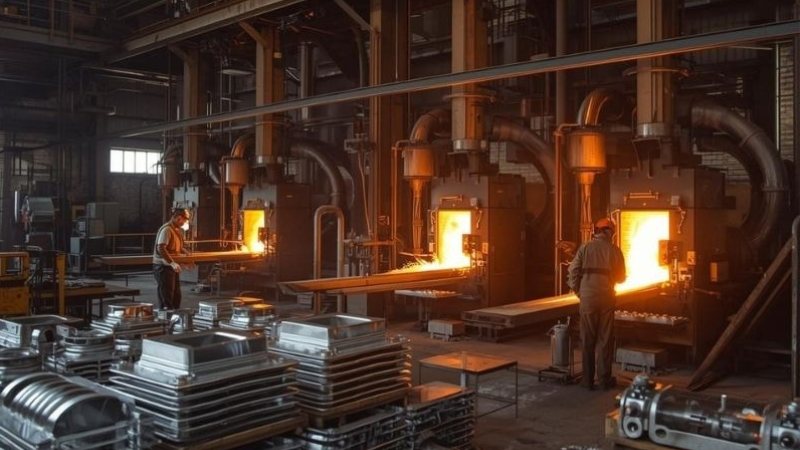
Alloys that are heat-treatable are strengthened by heating and aging. These alloys are composed of elements that respond positively to heat treatment. Examples of common heat-treatable series are
- 6xxx series (aluminum-magnesium-silicon alloys)
- 7xxx series (aluminum-zinc alloys)
- 2xxx series (aluminum-copper alloys)
These are alloys that are applied where high strength is needed. Typical applications are aerospace, structural, and automotive components and consumer electronics.
Non-Heat-Treatable Aluminum Alloys
Heat strengthening cannot be done on non-heat-treatable alloys. These are alloys that are dependent on cold working. The common methods are rolling and stretching. Normally, non-heat-treatable groups are
Non-Heat-Treatable (Typically Wrought) Series:
- 1xxx series (pure aluminum)
- 3xxx series (aluminum-manganese)
- 5xxx series (aluminum-magnesium)
They are typically non-heat-treatable alloys, and their strength is primarily enhanced through cold working.
Note on 4xxx series (aluminum-silicon):the 4xxx family contains both heat-treatable and non-heat-treatable alloys depending on the specific composition and application.
These are alloys that are selected because of their corrosion and formability. They find common use in packaging, marine, and electrical uses.
Key Heat Treatment Processes for Aluminum
There are a number of processes for aluminum heat treating. Every process has its purpose. This is determined by the alloy and the eventual usage.
Solution Heat Treatment
The aluminum is strengthened through a solution heat-treated process. The aluminum is made white hot. This range is normally between 460°C and 540°C. Certain temperatures vary depending on the alloy.
At this specific temperature, the elements that make an alloy are dissolved in the aluminum. These components are copper, magnesium, and silicon. This time is the duration of time the metal is in position. This enables the structure to become homogenous.
It has been found that effective treatment before solid solution enhances final strength. This step is critical. In its absence, the aluminum is not able to achieve maximum strength during aging.
Quenching
Quenching rapidly cools aluminum using water, air, or polymer solutions to retain a supersaturated solid solution. Operating the process with water, air, or polymer solutions cools the aluminum. Cooling must happen quickly. This fixes the alloying elements.
The quenching forms a supersaturated structure. This is an unstable structure that needs strengthening. Faulty quenching leads to trouble. These consist of distortion, cracking, and skewed strength. This is critical to control.
Aging (Natural and Artificial)
As the aluminum ages, it becomes stronger. When quenched, aluminum starts to gain strength in a natural way. This occurs at room temperature. This is termed natural aging. It can take several days.
The process is accelerated by artificial aging. Aluminum is reheated at a lower temperature. This is mostly between 120°C and 200°C. The metal is fabricated there for some hours.
Aging is generated by a process called the artificial aging process that gives consistent outcomes. Research indicates strength gains of above 60.7% of artificial alloys. This technique is common in the industry.
Annealing
Annealing softens aluminum. The aluminum alloy is heated to about 300–415°C and then cooled slowly.It is then slowly cooled. This helps to become soft and more flexible.
Annealing eliminates internal stress. It also improves ductility. This enhances the bending or shaping of aluminum. This step typically precedes additional forming or machining.
Homogenizing
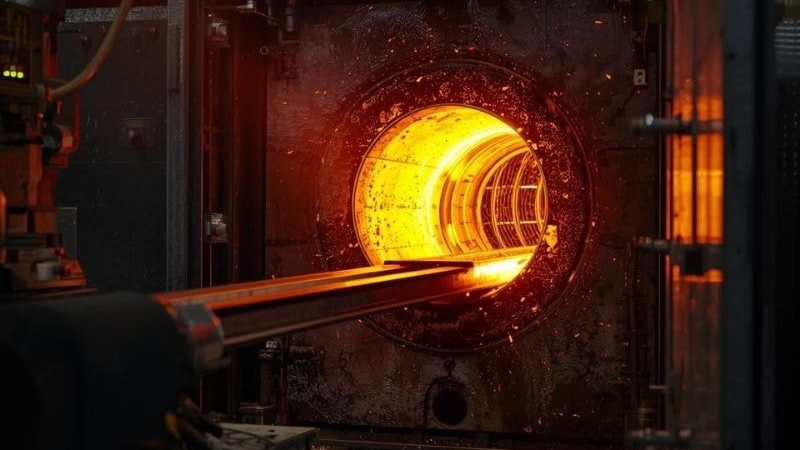
Aluminum uniformity is enhanced by homogenizing. The process is primarily applied to cast aluminum. It is applicable to slabs and billets. The aluminum is heated for a long period of time. This minimizes unevenly distributed chemicals. It also enhances internal consistency.
Homogenizing enhances extrusion and rolling. It assists in eliminating flaws in subsequent processing.
Common Challenges In Aluminum Heat Treatment
During heat treatment, there must be strict control.
- Distortion is one of the common problems. Aluminum can be altered in the process, which involves heating and quenching. Unequal hardness may also happen.
- Another issue is surface oxidation. This occurs in the case of a high-temperature reaction between aluminum and air. Quench cracking can be experienced when there is an excessive rate of cooling.
- Blistering can also form. This is due to gases that are trapped within the metal. Such issues are minimizable.
Thermal-induced porosity and surface flaws may be avoided with careful temperature management and clean furnace conditions, according to research on aluminum heat-treating processing. Consistency and quality are enhanced through regular inspections.
FAQs
Which is the best heat treatment for aluminum?
No best heat treatment of aluminum exists. The optimum process is based on the alloy and the purpose of its use. In the case of heat-treatable alloys, solution heat treatment and then artificial aging (like T6) provide the most desirable ratio of strength, hardness, and durability.
Is it possible to heat-treat aluminum in order to harden it?
Yes. The alloys of aluminum that can be heat-treated can be greatly hardened by controlled heating and aging. This is done to make the finished product stronger and harder, but without altering its shape.
Can 6061 aluminum be heat-treated?
Yes. 6061 aluminum can be heat-treated in the T6 condition, which involves solution heat treatment and artificial aging to attain a high-strength level and good corrosion resistance.
What is the heat treatment of aluminum?
Aluminum heat treatment is a process of heating, then cooling down, which is a controlled process with the aim of enhancing the mechanical properties of aluminum alloys, like strength, hardness, and fatigue resistance. It is primarily used with heat-treatable alloys of aluminum.
What changes after aluminum is heat-treated?
Heat-treated aluminum is typically stronger and harder than untreated material, although ductility may decrease depending on the alloy and temper.
Conclusion
Aluminum heat treatment is a critical process in contemporary manufacturing. It enhances the strength, hardness, and longevity without altering the shape of the metal. Controlled heating and cooling enable the manufacturers to modify the properties of aluminum to fit certain purposes.
It is important to know that heat-treatable alloys exist before choosing a process. Each solution heat treatment, quenching, aging, annealing, and homogenizing, has a distinct purpose. Heat treatment is done properly to provide aluminum parts that are of high quality in terms of their industrial standards.
This idealizes aluminum in aggressive industries like construction, automotive, aerospace, and industrial manufacturing.
Get High-Quality Heat-Treated Aluminum Solutions!
Honjenny offers aluminum products with precision engineering. Our solutions are within high industrial standards. To see our entire product range, visit our homepage. Get in touch with our team to know more about your project requirements and needs.