
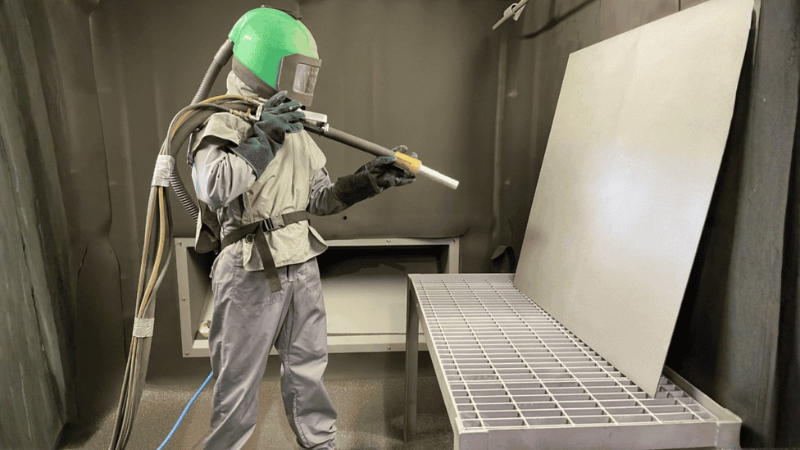
Sandblasting is a common surface treatment process used to remove rust, strip old coatings, clean metal surfaces, and prepare parts for finishing. While the term is still widely used, it often refers more broadly to abrasive blasting methods that use different media depending on the material and desired surface finish.
This article explains what sandblasting is, how the process works, its main industrial uses, the most common blasting media, and how it differs from bead blasting. You will also learn when sandblasting is the right choice, when it may not be ideal, and what to consider if surface finish, coating adhesion, or part sensitivity matters.
What Is Sandblasting?
Sandblasting is a surface treatment process that propels abrasive media at high speed onto a workpiece. The impact of the media removes contaminants, old coatings, rust, oxidation, burrs, or other unwanted surface layers. It can also create a specific texture or surface profile.
The term “sandblasting” is still widely used in manufacturing, but it is not always a literal description of the blasting media. In many practical discussions, people use “sandblasting” as a general term for abrasive blasting, even when the process actually uses glass beads, aluminum oxide, steel grit, or other abrasives. As a result, the word often refers to a broader category of surface treatment processes rather than blasting with sand alone.
How the Sandblasting Process Works
Sandblasting works by propelling abrasive media at high speed onto a part’s surface. The impact removes rust, old coatings, oxidation, and other contaminants, while also changing the surface texture.
In most systems, the abrasive is pushed through a nozzle using compressed air and directed at the workpiece. As the media hits the surface, it cleans, strips, or roughens the material depending on the blasting media, pressure, angle, and distance.
Because these variables can be adjusted, sandblasting can be used for both heavy-duty surface cleaning and more controlled surface preparation before painting, powder coating, or other finishing processes.
What Are the Practical Uses of Sandblasting?
Sandblasting is mainly used to clean surfaces, prepare parts for finishing, and improve overall surface condition. In manufacturing and industrial applications, its practical uses usually fall into three main categories.
1 Rust and Coating Removal
One of the most common uses of sandblasting is removing unwanted surface layers such as rust, corrosion, oxidation, mill scale, old paint, and other contaminants.
Steel brackets, machine frames, fabricated parts, and industrial components are often blasted when the surface needs to be stripped back to a cleaner and more workable condition before further processing or refinishing.
2 Preparing Surfaces
Sandblasting is also widely used before painting, powder coating, or other protective finishes.
By removing contamination and creating a more suitable surface profile, it helps coatings adhere more effectively and perform more consistently over time. This is a common step for welded steel enclosures, fabricated housings, and other metal parts that require durable surface finishing.
3 Improving Surface Appearance
In some applications, sandblasting is used to create a more even and consistent surface appearance.
After fabrication, machining, or repair, metal parts may show localized discoloration, residue, or uneven texture. A controlled blasting process can help reduce these inconsistencies and produce a cleaner, more uniform finish before the next stage of manufacturing or finishing.
Abrasive Materials Used in Sandblasting
1. Glass Beads
Glass beads are commonly used when a cleaner and more uniform surface appearance is needed. Because they are round, they are generally less aggressive than sharp-edged abrasives and are often chosen for parts where appearance matters.
Surface result: a smoother, more even matte or satin finish.
2. Aluminum Oxide
Aluminum oxide is a harder and more aggressive abrasive. It removes surface material more quickly and is often selected when the goal is stronger cleaning action or better surface preparation before coating.
Surface result: a rougher, more etched surface profile.
3. Steel Shot and Steel Grit
Steel shot and steel grit are often used for heavier industrial blasting. Steel grit is more angular and cuts more aggressively, while steel shot is rounder and creates a denser, more impact-based surface effect.
Surface result: stronger cleaning action and a more durable surface profile on steel parts.
4. Soft Media
Soft media such as soda, walnut shell, or plastic abrasives are used when the surface needs to be cleaned without excessive damage to the substrate. These media are less aggressive and are better suited to lighter cleaning work.
Surface result: gentle cleaning with limited surface change.
Because different media create different surface results, media selection is one of the most important decisions in sandblasting. It determines whether the process functions mainly as a cleaning method, a surface preparation step, or a finishing process.
Sandblasting vs Bead Blasting
Although both processes use abrasive media to treat a surface, they are used for different purposes and can produce very different results.
When Sandblasting Is a Good Choice
Sandblasting is a strong option when the surface condition is relatively poor or when adhesion matters more than cosmetic refinement.
It is a good choice for:
- ✔ removing rust, scale, or heavy oxidation
- ✔ stripping old coatings
- ✔ preparing metal for painting or powder coating
- ✔ cleaning fabricated steel structures
- ✔ restoring worn industrial components
- ✔ creating a more active surface for downstream finishing
If the part is robust, the contamination is heavy, and the finish requirement is functional rather than decorative, sandblasting can be very effective.
When Sandblasting Is Not the Best Choice
Sandblasting is not always the right answer. In fact, one of the clearest signs of manufacturing expertise is knowing when not to use it.
It may not be the best choice for:
- ✖ thin-wall parts that can be affected by aggressive impact
- ✖ precision components with tight dimensional requirements
- ✖ cosmetic parts requiring a refined satin appearance
- ✖ soft materials that can be damaged easily
- ✖ components where media contamination is a concern
- ✖ parts that need a very controlled and repeatable visual finish
For these situations, a gentler blasting method, a different media, or even a different surface treatment process may be better.
This matters especially in custom manufacturing, because choosing the wrong blasting method can lead to inconsistent appearance, excessive roughness, or unnecessary rework.
Safety Considerations in Sandblasting
Airborne dust is one of the biggest safety concerns.
During sandblasting, both the blasting media and the material removed from the surface can become airborne, which may create health risks if dust control is inadequate.
The removed material can be just as important as the blasting media itself.
Old coatings, corrosion, and surface residues may release harmful particles during blasting, so the process should account for what is being removed from the part, not just what is being used to clean it.
Proper ventilation and dust collection are essential.
In industrial environments, enclosed systems and dust control equipment help reduce airborne exposure and improve overall process safety.
Protective equipment is necessary for operator safety.
Because sandblasting involves flying particles and dust, suitable protective gear is an important part of safe operation.
Safe sandblasting depends on process control.
A well-managed blasting process should balance cleaning efficiency, surface quality, and workplace safety rather than focusing on speed alone.
FAQS
Conclusion
Sandblasting is a versatile and highly effective surface treatment process used for cleaning, preparation, restoration, and finishing. However, the best results do not come from treating all blasting processes the same.
The most important decision is not simply whether to sandblast a part. It is choosing the right blasting method, the right media, and the right process settings for the material, finish requirement, and downstream use.
In manufacturing, surface treatment is never just a final touch. It affects appearance, performance, coating adhesion, and product quality. That is why understanding sandblasting in a deeper, more practical way leads to better engineering and purchasing decisions.
Need the Right Surface Finish for Your Parts?
At honjenny, we help manufacturers, engineers, and sourcing teams choose the right surface treatment for their parts, from sandblasting and bead blasting to other finishing solutions based on material, appearance, and application requirements. If you are looking for a reliable partner for custom metal parts and surface finishing, send us your drawings or project requirements today and our team will help you evaluate the best option for your application.