
Choosing a casting process affects more than the initial tooling price. It also influences filling quality, dimensional stability, machining time, surface finish, production yield, and final part cost.
This guide explains the main metal casting methods used from prototype development to high-volume production. It compares each process by material, geometry, accuracy, tooling investment, and production volume.
At Honjenny, we have reviewed projects where a low-cost mold created higher machining expenses and unstable quality during production. The following sections explain the main casting methods and show how to select a practical process for your metal part.
What Are the Main Types of Casting?
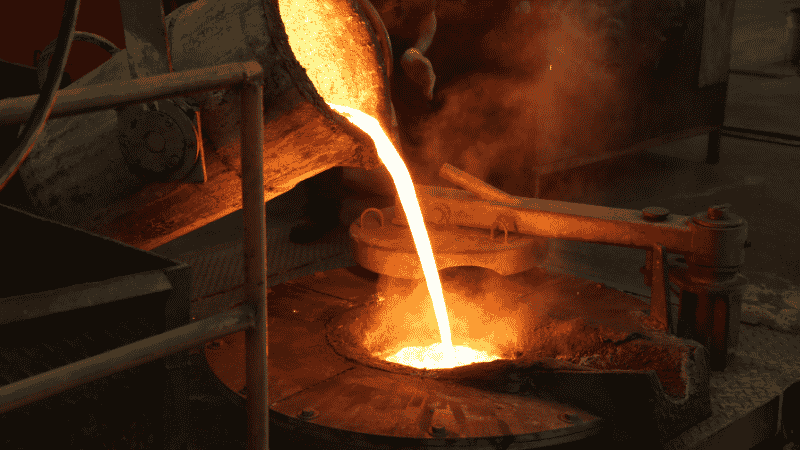
Casting is a manufacturing process in which molten metal enters a mold cavity, cools, and solidifies into the required shape.
Manufacturers use casting to produce housings, brackets, covers, valves, heat sinks, machine bases, structural parts, and components with internal cavities. Depending on the process, casting can support small precision parts, large industrial components, prototypes, or millions of repeat production units.
Common casting alloys include:
- Aluminum alloys
- Zinc alloys
- Magnesium alloys
- Cast iron
- Carbon and alloy steel
- Stainless steel
- Copper and bronze alloys
Most cast parts still require additional operations. These may include trimming, deburring, CNC machining, heat treatment, powder coating, plating, leak testing, dimensional inspection, and assembly.
How Are Casting Types Classified?
The main casting types can be divided into expendable-mold and non-expendable-mold processes.
Expendable-Mold Casting
An expendable mold is destroyed when the casting is removed. A new mold must be prepared for every production cycle.
Sand casting, shell mold casting, plaster mold casting, investment casting, and lost foam casting belong to this group. These methods usually provide greater flexibility for complex shapes or low-volume production, but production speed may be slower.
Non-Expendable-Mold Casting
A non-expendable mold can be reused for many production cycles. It is normally made from steel, iron, graphite, or another durable material.
High pressure die casting, gravity die casting, low-pressure casting, vacuum die casting, squeeze casting, and centrifugal casting use reusable molds. The tooling cost is normally higher, but repeatability and production efficiency improve as volume increases.
12 Types of Metal Casting Processes
The following types of metal casting differ in mold construction, filling pressure, suitable alloys, achievable tolerance, surface quality, and production volume.
1. Sand Casting
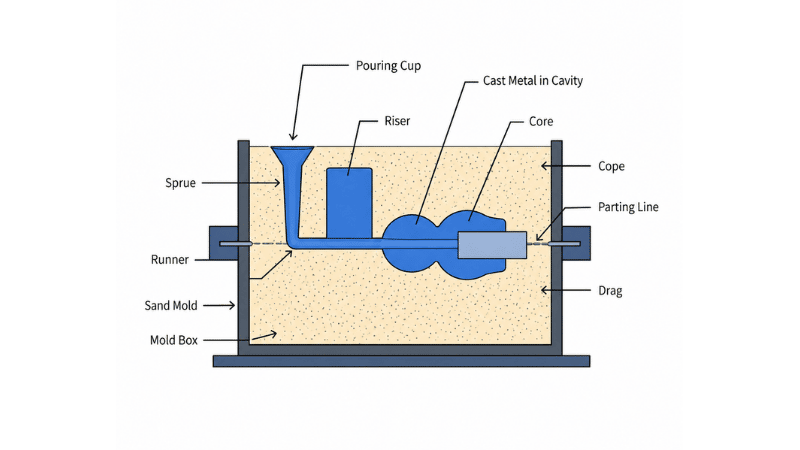
Sand casting forms a cavity inside compacted sand and pours molten metal into it. It supports a wide range of alloys and part sizes.
The process is suitable for machine bases, pump housings, large brackets, engine blocks, and heavy industrial components. Tooling is relatively inexpensive, making it practical for prototypes and low-volume production.
Its main limitations are rougher surfaces, wider tolerances, and larger machining allowances. Thin walls and small precision features are also harder to control than with die casting.
2. Shell Mold Casting
Shell mold casting uses resin-coated sand to create a thin, rigid mold shell. Compared with conventional sand casting, it normally provides better surface quality and dimensional repeatability.
It is suitable for small and medium-sized valves, gears, connecting rods, and mechanical components. However, mold preparation costs more than ordinary sand molding, and part size is more restricted.
3. Plaster Mold Casting
Plaster mold casting uses a gypsum-based mold to reproduce fine details and smooth surfaces. It is mainly used with aluminum, magnesium, zinc, and copper-based alloys.
The process works well for low-volume parts with detailed surfaces. Its slow mold preparation and limited resistance to high casting temperatures make it unsuitable for most steel and cast iron parts.
4. Investment Casting
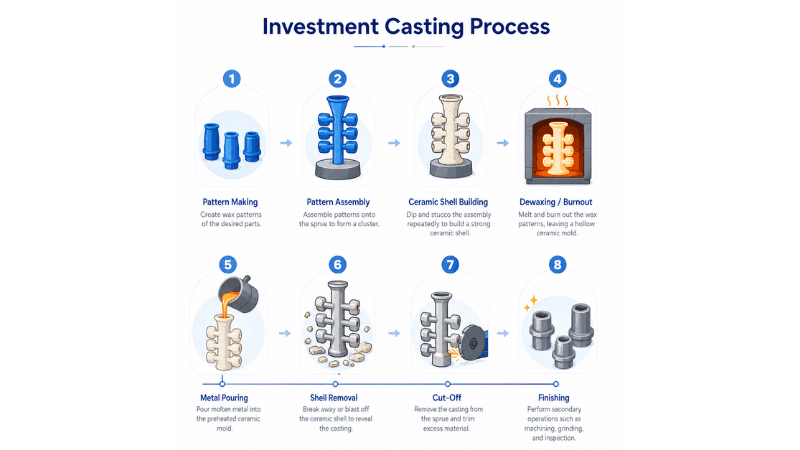
Investment casting is also known as lost wax casting. A wax pattern receives several ceramic coatings to form a shell. The wax is then removed before molten metal enters the cavity.
This process supports complex geometry, thin sections, fine details, and materials that are difficult to machine. It is widely used for stainless steel valves, turbine components, medical instruments, and precision hardware.
Investment casting offers good accuracy and surface finish, but the production cycle is longer than die casting. Pattern preparation, ceramic shell building, and shell removal also increase the unit cost.
5. Lost Foam Casting
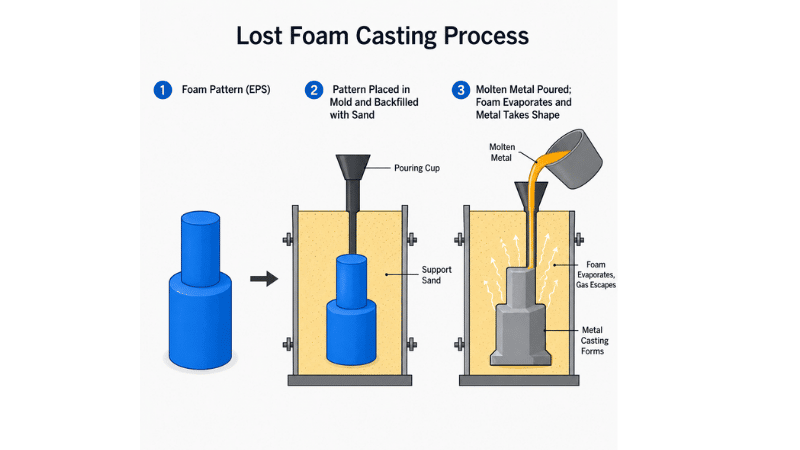
Lost foam casting uses an expendable foam pattern embedded in sand. When molten metal enters the mold, the foam vaporizes and the metal fills the remaining space.
The process can create complex parts without separate cores or conventional parting lines. It is used for engine components, pump bodies, and cast iron parts with internal passages.
Process stability depends heavily on foam quality, coating control, pouring temperature, and gas removal. Surface finish and dimensional consistency may not match investment casting or die casting.
6. Gravity Die Casting
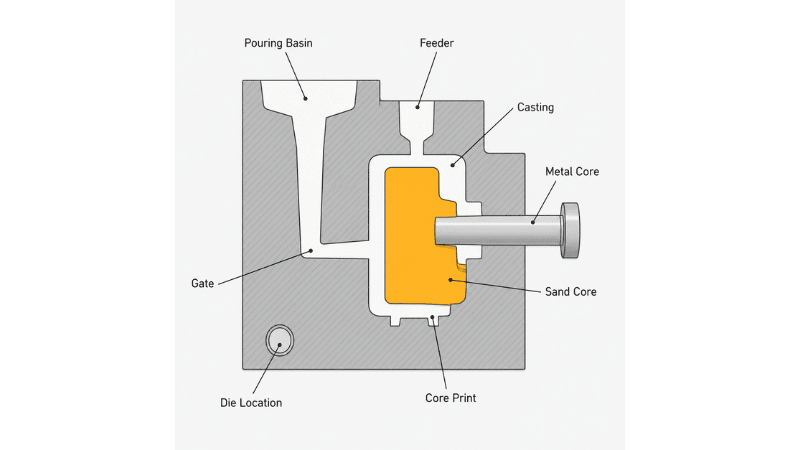
Gravity die casting, also called permanent mold casting, uses a reusable metal mold. Molten metal fills the cavity mainly through gravity rather than high injection pressure.
It is suitable for medium-volume aluminum parts with moderate wall thickness and relatively simple geometry. Typical applications include cookware, automotive brackets, pump housings, and structural components.
The metal mold produces a better surface than sand casting and can be used for many cycles. However, gravity filling is less effective for very thin walls, narrow ribs, or long flow paths.
7. High Pressure Die Casting
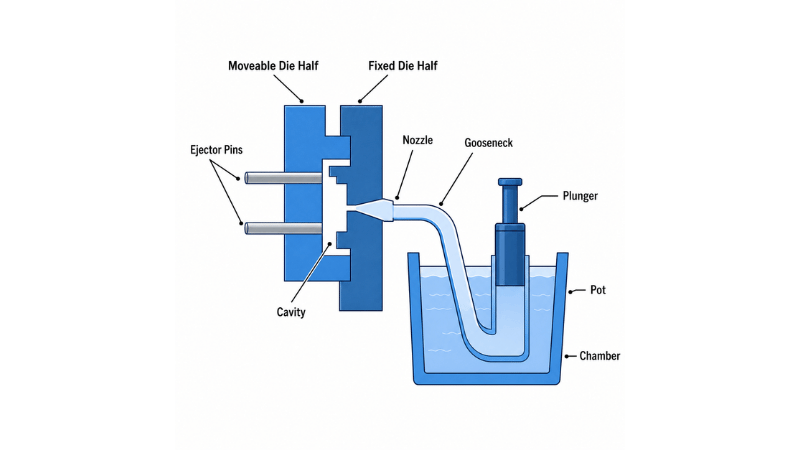
High pressure die casting injects molten metal into a steel mold at high speed and pressure. It is widely used for aluminum, zinc, and magnesium parts requiring thin walls, detailed features, stable dimensions, and fast production.
Aluminum die casting is commonly selected for housings, heat sinks, automotive parts, communication enclosures, and structural components. Zinc die casting is suitable for smaller precision parts, thin walls, fine details, threads, latches, and decorative surfaces.
Tooling requires a higher initial investment and often takes several weeks to design, manufacture, and validate. However, the process can reduce unit cost, machining time, and production variation at medium or high volume.
8. Low-Pressure Casting
Low-pressure casting uses controlled gas pressure to move molten metal upward into the mold. The smooth filling direction reduces turbulence and improves feeding during solidification.
The process is widely used for aluminum wheels, suspension parts, and structural castings. It offers better control over filling and shrinkage than gravity pouring, but its cycle time is generally slower than high pressure die casting.
9. Vacuum Die Casting
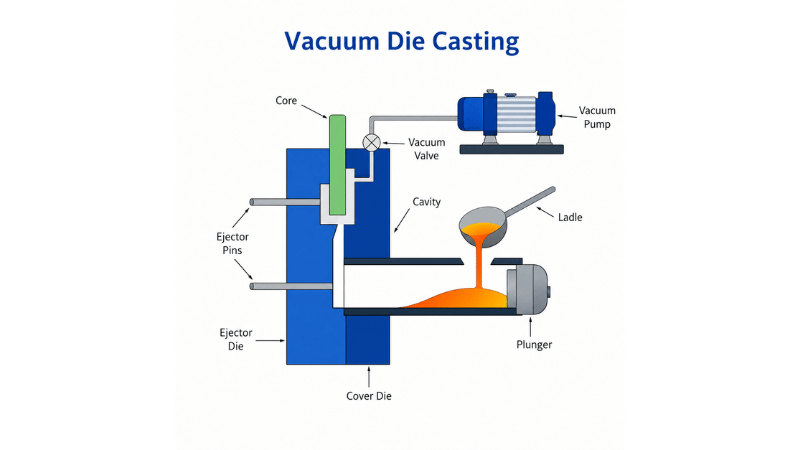
Vacuum die casting removes air from the cavity and runner system before or during metal injection. It is a variation of high pressure die casting used to reduce trapped gas.
The process is valuable for sealed housings, structural aluminum parts, machined sealing surfaces, and components that require powder coating. Lower gas content can improve leak-test performance and reduce the risk of surface blistering during coating bake cycles.
Vacuum die casting still requires correct gate design, venting, injection settings, and melt control. Vacuum alone cannot correct poor part design or unstable process parameters.
10. Squeeze Casting
Squeeze casting fills a mold and applies pressure while the metal solidifies. The pressure improves feeding and reduces internal shrinkage.
It is suitable for aluminum structural parts that require greater density, strength, or heat-treatment potential. The process may be selected for suspension components, wheels, and load-bearing parts.
Semi-solid metal processing follows a related principle but forms metal in a partially solid state. It can reduce turbulence, although the equipment and material preparation are more specialized.
11. Centrifugal Casting
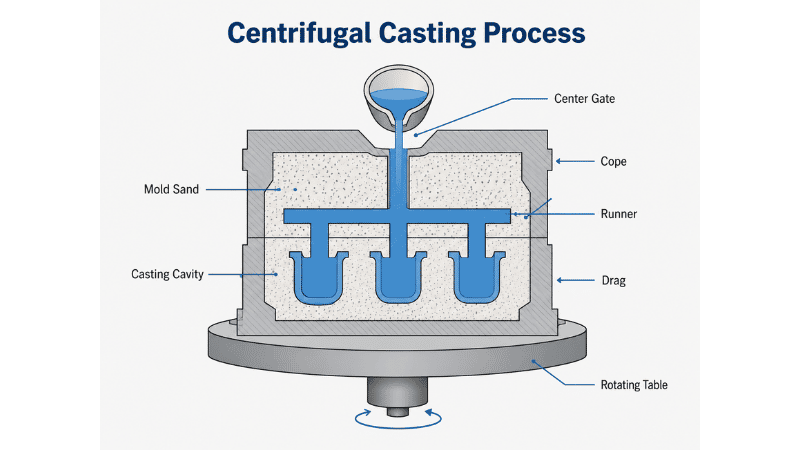
Centrifugal casting rotates the mold while molten metal enters it. Centrifugal force moves the metal toward the outer mold wall.
The method is mainly used for pipes, bushings, rings, liners, and other cylindrical parts. It can produce dense material in the functional outer section of the casting.
Its main limitation is geometry. The process is not suitable for most irregular housings or components with complex external features.
12. Continuous Casting
Continuous casting solidifies molten metal into a continuous billet, slab, bar, rod, or strip. The product is cut to length before rolling, extrusion, forging, or machining.
It supports very high-volume material production and provides consistent feedstock for later manufacturing processes. However, it does not produce finished complex components and requires substantial equipment investment.
Production Risks That Casting Drawings May Not Show
A drawing may define dimensions and tolerances without explaining how the part will behave during coating, assembly, machining, or long-term use.
In one outdoor power supply housing project, the drawing specified external dimensions, assembly holes, cosmetic requirements, and 0.1 mm flatness. Three production risks only became clear during DFM review and trial production.
The four internal M4 bosses had sharp root transitions and a local wall thickness of only 1.6 mm. In the first 100 trial castings, 16 parts developed microcracks near the boss roots. Adding an R0.8 fillet and triangular support ribs reduced the cracking to almost zero.
The raw castings also appeared acceptable before powder coating. During the baking cycle, hidden surface pinholes expanded and produced blisters. We moved the gate to the bottom mounting surface, added vents and overflow wells, and introduced sandblasting before coating. Powder coating yield increased from about 60% to 96%.
The bottom mounting face created another issue. Parts met the 0.1 mm flatness requirement immediately after machining but warped after two or three days as residual stress was released.
We increased the machining allowance from 0.3 to 0.5 mm, separated rough and finish machining, and added 0.08 mm of reverse compensation to the mold. Production flatness then stabilized between 0.07 and 0.09 mm.
These problems were not caused by missing dimensions. They resulted from coating temperature, screw loading, machining sequence, and residual stress that the original drawing did not fully communicate.
How to Choose the Right Type of Casting
The right type of casting depends on the part, not on a single process advantage.
Consider these factors before approving tooling:
- Alloy and mechanical requirements
- Annual production volume
- Part dimensions and weight
- Minimum wall thickness
- Internal cavities and complex features
- Dimensional tolerances
- Cosmetic surface requirements
- Sealing or pressure-tightness requirements
- CNC machining allowance
- Surface finishing process
- Tooling budget
- Target unit cost
- Required delivery schedule
Sand casting may suit a large, low-volume machine housing. Investment casting may suit a complex stainless steel valve. Gravity die casting may suit a medium-volume aluminum bracket. High pressure die casting may suit a thin-wall enclosure produced in repeat batches.
For precision parts, compare total manufacturing cost. Include tooling, casting, machining, rejects, inspection, finishing, assembly, inventory, and delivery.
Comparison of the Main Types of Metal Casting
Metal Casting Selection Checklist
Before requesting a quotation, confirm:
- CAD model and controlled 2D drawing
- Required alloy or material performance
- Estimated annual volume
- Critical and non-critical tolerances
- Cosmetic and functional surfaces
- Sealing, pressure, or leak-test requirements
- Coating, plating, anodizing, or painting requirements
- Threaded bosses, inserts, ribs, and sealing grooves
- CNC machining datums and allowances
- Inspection and regulatory requirements
- Prototype and sample validation plan
An early DFM review can identify filling, shrinkage, cracking, warpage, machining, and surface treatment risks before tooling begins.
Quality, Safety, and Compliance Considerations
Casting quality control may include CMM inspection, X-ray inspection, leak testing, dimensional checks, coating tests, and assembly verification. The inspection plan should focus on the final function of the part rather than applying the same control level to every dimension.
Molten metal handling also requires protective equipment, dry tools, controlled furnace operation, ventilation, and clear emergency procedures.
For regulated projects, confirm the applicable requirements before production. These may include ISO 9001, IATF 16949 for automotive supply chains, RoHS, REACH, PPAP documentation, or customer-specific inspection standards.
FAQs
Which casting process is suitable for precision aluminum parts?
High pressure die casting is often suitable for medium- and high-volume aluminum parts with thin walls, detailed features, and stable dimensional requirements. Gravity, low-pressure, squeeze, or investment casting may be more appropriate for other structures and performance requirements.
Is die casting always cheaper than sand casting?
No. Die casting requires more expensive tooling. It becomes economical when production volume, machining reduction, cycle time, and repeatability justify the investment.
Why do casting defects appear after powder coating?
Small surface pores may contain trapped gas. During the coating bake cycle, the gas expands and can create pinholes or blisters. Gate design, venting, vacuum control, and surface preparation can reduce this risk.
When should a DFM review take place?
Complete the DFM review before final mold design. The review should cover wall thickness, draft, ribs, bosses, gates, vents, machining datums, coating, assembly loads, and inspection requirements.
What should I provide for a casting quotation?
Provide the 3D CAD model, 2D drawing, alloy, estimated annual volume, tolerance requirements, surface finish, inspection standards, and operating conditions. After mold completion, Honjenny typically prepares initial samples in 7–10 days, depending on tooling complexity and validation requirements.
Conclusion
Each casting process serves a different combination of geometry, alloy, volume, tolerance, and cost. A lower mold quotation does not always produce a lower project cost when machining, defects, finishing, and delivery are included.
Define the functional requirements first, then compare the processes against the full production workflow. Early DFM review and prototype validation can prevent expensive mold changes after production begins.
Get a Quote for Custom Metal Parts
Honjenny provides aluminum die casting, zinc die casting, mold manufacturing, CNC machining, surface finishing, inspection, and assembly for custom metal parts.
Send your CAD file, drawing, material requirement, annual volume, and surface finish specification to request a DFM review and production quotation.