
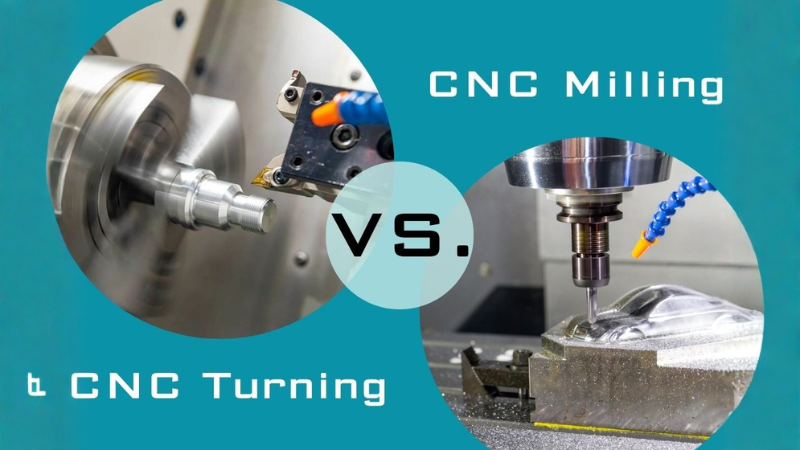
When sourcing CNC machined parts, one of the most common questions is whether CNC turning or CNC milling is the better choice.
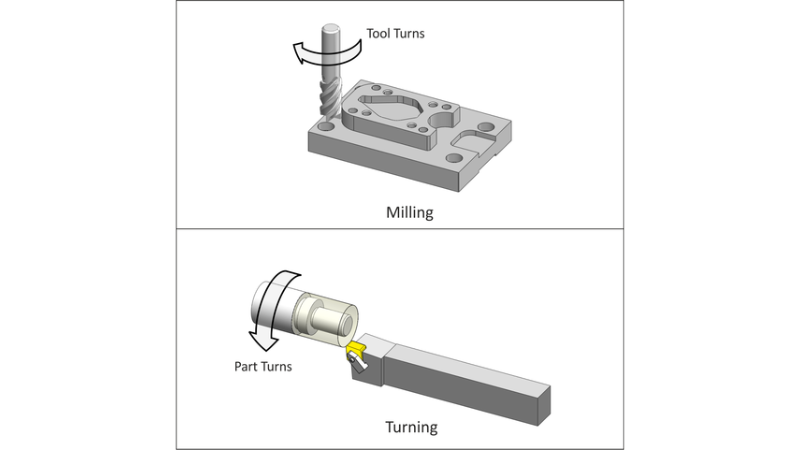
CNC turning rotates the workpiece while a cutting tool removes material. In contrast, CNC milling keeps the workpiece stationary while rotating cutting tools create intricate shapes, slots, and holes. Although both are widely used precision machining processes, understanding their differences is essential for selecting the right option for specific applications.
Choosing the wrong process can lead to unnecessary machining costs, longer lead times, more setups, avoidable tolerance risks, and inefficient production planning. This guide explores the key features, differences, applications, and selection factors of CNC turning and milling to help you make the most suitable choice for your project.
CNC Turning vs Milling — Quick Comparison
If you need a fast answer, use this simple decision guide:
Choose CNC Turning if:
- your part is primarily cylindrical or rotational
- you need shafts, pins, bushings, rods, or threaded round parts
- you want lower unit cost in medium-to-high volume production
- concentricity and roundness are critical
Choose CNC Milling if:
- your part has flat faces, pockets, slots, holes, or complex contours
- your design requires multi-side machining
- you are producing prototypes or low-volume custom parts
- geometric flexibility matters more than simple cycle speed
Choose Both Turning and Milling if:
- your part includes both round and prismatic features
- you need a cylindrical base plus flats, cross holes, slots, or milled details
- reducing setups and improving total accuracy is important
In short:
Turning is usually best for rotational parts.
Milling is usually best for complex, non-round parts.
Combined machining is often best for hybrid parts.
What is CNC Turning?
The lathe-based machining process shapes a rotating workpiece using a stationary cutting tool. It’s a highly precise + fast + cost-effective approach for rotational geometries in high-volume production.
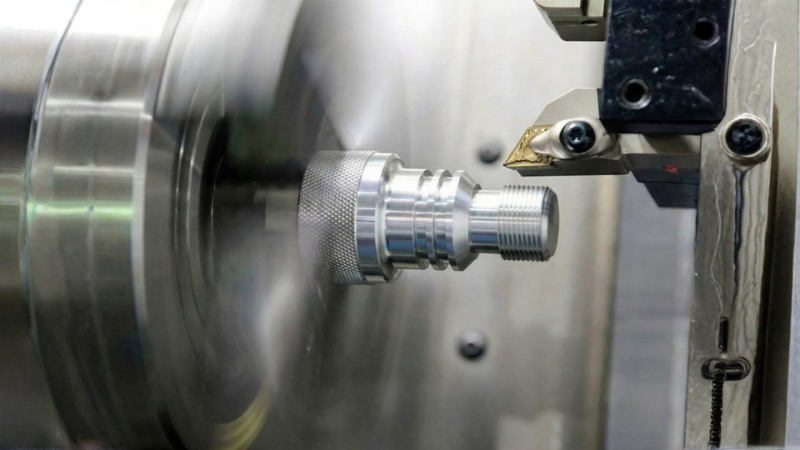
What Parts Are Best for CNC Turning?
- Cylindrical Parts: Shafts, rods, and pins.
- Bushings: Common in automotive parts and industrial machinery.
- Threads: Internal and external threading for fasteners.
Advantages of CNC Turning
- fast cycle times for cylindrical parts
- lower setup complexity for rotational geometry
- excellent concentricity and roundness
- cost-effective for medium and high volumes
Why Manufacturers Choose CNC Turning
CNC turning is generally preferred when the part geometry is simple, round, and repeatable. It is especially efficient for production runs where speed, consistency, and lower per-part cost are priorities.
What Is CNC Milling?
CNC milling refers to the process of removing material from a stationary workpiece using a rotating cutting tool. Unlike turning, CNC milling can offer multi-axis capability (commonly 3 axis, 4 axis, or even 5 axis).
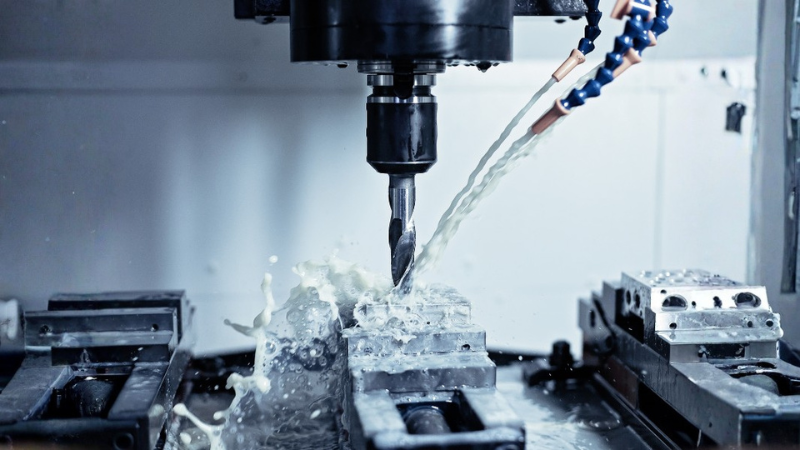
What Parts Are Best for CNC Milling?
- Complex Shapes: Aerospace turbine blades or medical implants.
- Flat Surfaces: Common in housings and casings.
- Pockets and Slots: Used in mold-making and electronics.
- 3D Geometries: Perfect for prototypes and custom designs.
Advantages of CNC Milling
- supports complex geometries
- suitable for flat and irregular surfaces
- flexible for prototyping and custom parts
- multi-axis capability for advanced machining (3 axis, 4 axis, or 5 axis)
Why Manufacturers Choose CNC Milling
CNC milling is the better option when the part shape is not rotational, or when the design includes multiple surfaces and features that cannot be created efficiently on a lathe alone.
Comparison Table: Difference Between CNC Turning and Milling
To make the differences easier to understand, the table below presents a clear comparison of CNC turning and CNC milling.
CNC Turning vs Milling: The Key Differences That Affect Buying Decisions
1. Part Geometry: The First Decision Factor
Part geometry is often the most important factor when choosing between CNC turning and CNC milling. In general, turning is better suited to parts with rotational symmetry, while milling is more appropriate for parts with flat surfaces, pockets, slots, and more complex shapes.
When a design includes both cylindrical and non-rotational features, combining both processes may be the most practical solution.
2. Complexity: How Much Detail Does the Part Require?
Part complexity is another key factor in process selection. CNC turning is highly efficient for simpler rotational features, but it becomes less practical as the design includes more non-symmetrical details.
CNC milling, on the other hand, offers greater flexibility for parts with multiple surfaces, intricate contours, and complex features. In general, the more detailed and geometrically varied the part is, the more likely milling will be the better choice.
3. Cost: Which Process Is More Economical?
Cost should be evaluated based on the overall manufacturing route rather than machine type alone.
CNC turning is usually more economical for simple cylindrical parts, especially in medium- to high-volume production, because it often involves faster cycle times and lower setup requirements.
CNC milling has higher setup cost due to complex CAD/CAM programming and multi-axis calibration, but it can be more cost-effective for complex parts by reducing the need for additional operations or secondary setups. The most economical process depends on part geometry, batch size, and machining requirements.
4. Tolerance: Where Does Precision Matter Most?
Tolerance requirements should be considered based on the critical features of the part.
CNC turning is typically preferred when roundness, concentricity, and diameter control are the main priorities.
CNC milling is often the better option when precision is required across multiple surfaces, positions, or complex features.
In many cases, the best choice is determined not by which process is more accurate overall, but by which one is better suited to the specific tolerances that matter most in the design.
Process Selection in Real-World Applications
At Honjenny, we select CNC turning or CNC milling based on the actual geometry and functional requirements of each part. The examples below show how the right process is determined in real manufacturing applications.
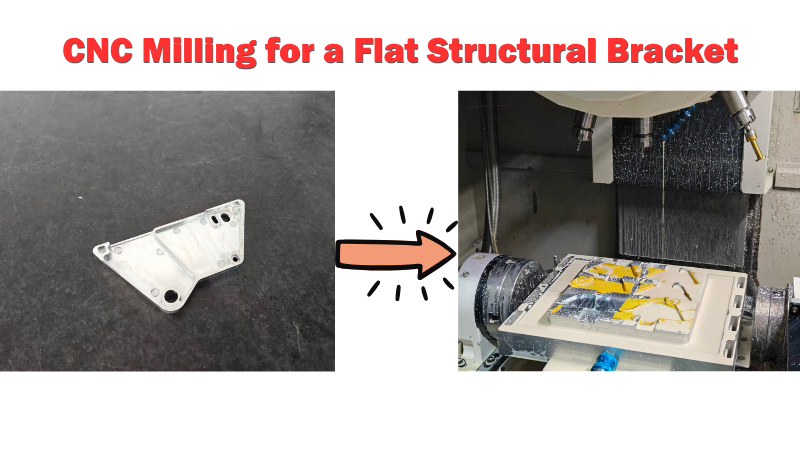
Example 1: CNC Milling for a Flat Structural Bracket
The first part is a flat aluminum bracket with multiple drilled holes, an elongated slot, machined pockets, and an irregular outer profile. This type of component is a typical example of CNC milling, because the part requires machining across a flat surface with several non-rotational features. The combination of contouring, slotting, pocketing, and hole-making makes milling the more practical and efficient process.
Why milling was selected:
- The part has a flat, non-cylindrical geometry
- It includes multiple surface features and cutouts
- Dimensional accuracy is required across several positions
- The overall shape cannot be produced efficiently by turning
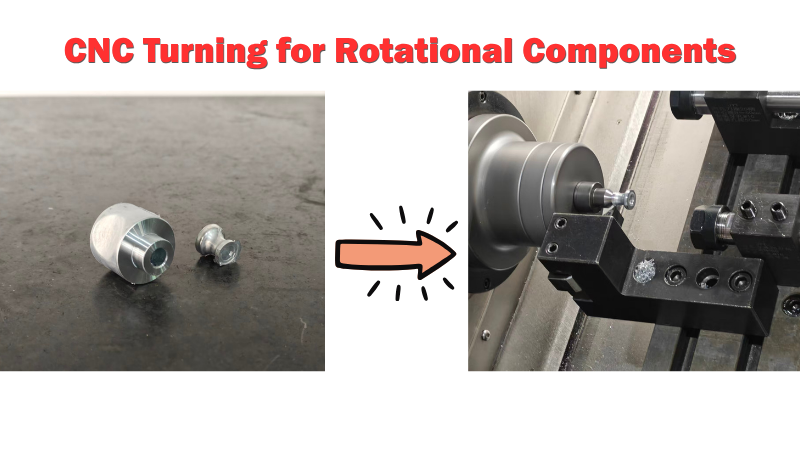
Example 2: CNC Turning for Rotational Components
The second image shows two round metal parts with clear rotational symmetry. Their external diameters, stepped profiles, and central hole features make them well suited to CNC turning. For components like these, turning provides better efficiency, smoother concentric surfaces, and more reliable diameter control.
Why turning was selected:
- The parts are primarily cylindrical
- Key dimensions are based on diameter and concentricity
- The geometry is rotational and suitable for lathe machining
- Turning offers faster cycle times for this type of shape
Selection Insight
These examples illustrate a simple but important principle: milling is generally preferred for flat or complex prismatic parts, while turning is the better choice for round or rotational components. In practice, selecting the right process early helps reduce cost, avoid unnecessary setups, and improve manufacturing efficiency.
Can a Part Require Both Turning and Milling?
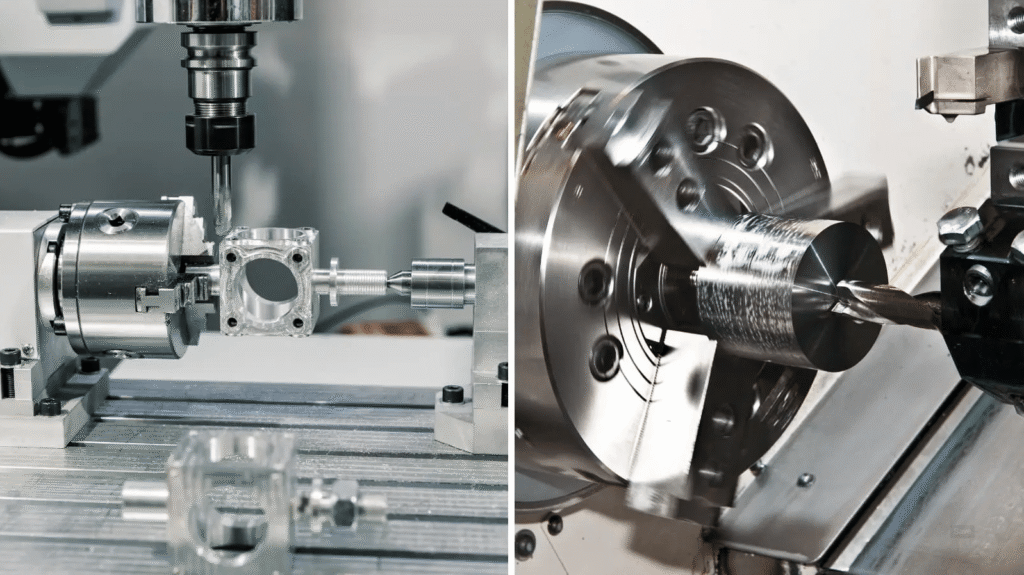
Yes. Many modern components require both CNC turning and milling to achieve the desired shape. Combining them allows manufacturers to produce hybrid parts with unmatched precision and efficiency.
When Are Both Processes Needed?
When a part has cylindrical features (like shafts or threads) and flat or complex geometries (like slots, holes, or pockets).
Common in industries where parts must integrate multiple functions – aerospace landing gear, automotive transmission shafts, or medical implants.
Examples of Hybrid CNC Parts
- Automotive: Transmission shafts with threads (turned) and key slots (milled).
- Aerospace: Landing gear components with cylindrical shafts (turned) and mounting holes (milled).
- Medical: Bone screws with threaded bodies (turned) and hexagonal heads (milled).
- Industrial Equipment: Pump housings with round connectors (turned) and complex slots (milled).
What Is Mill-Turn Machining?
Mill-turn machines combine both processes in a single setup. The workpiece can be rotated like in turning, while milling tools cut complex features without removing it from the machine.
Many Benefits of Combining Turning and Milling
- Efficiency: Reduces multiple setups and handling.
- Precision: Maintains tighter tolerances by machining in one setup.
- Cost Savings: Cuts down cycle time and tooling changes.
- Flexibility: Produces complex hybrid parts that neither process alone could achieve.
FAQs
- What are the disadvantages of CNC turning?
CNC turning is limited to cylindrical or symmetrical parts, so it cannot handle complex geometries like pockets or irregular shapes. It also requires specialized tooling for threads and fine details.
- Is CNC turning faster than CNC milling?
For cylindrical parts, CNC turning is usually faster. For parts with complex features, CNC milling is often the more practical option.
- Which is cheaper: turning or milling?
Turning is generally cheaper for high-volume cylindrical parts. Milling is more expensive per cycle, but it is cost-effective for prototypes or complex geometries.
- Can CNC turning and milling achieve the same surface quality?
Both can achieve good surface quality, but on different features. Turning is better for cylindrical surfaces, while milling is better for flat or complex surfaces.
- What materials can be machined?
CNC turning and milling can handle a wide range of materials like aluminum, steel, stainless steel, brass (metals), ABS, nylon, PEEK, acrylic (plastics), and titanium, Inconel, and high-performing exotic alloys.
Conclusion
CNC turning and CNC milling are both essential machining processes, but the right choice depends on the specific requirements of the part. In general, turning is more efficient for rotational components, while milling is better suited to parts with flat surfaces, complex features, and multi-sided geometries. For hybrid parts, combining both processes may be the most effective solution.
The key to making the right decision is not simply understanding how each process works, but knowing which one best matches your part geometry, tolerance requirements, production volume, and cost targets. By evaluating these factors early, manufacturers can reduce unnecessary machining costs, avoid extra setups, and improve overall production efficiency.
At Honjenny, we understand that selecting the right machining process is a critical part of project success. With the right process strategy, you can achieve better part performance, more stable quality, and a more cost-effective manufacturing route.
Best CNC Machining Support for Your Project at HONJENNY
Not sure whether your part requires CNC turning, CNC milling, or both?Send your drawing or 3D file to Honjenny for a professional process review and quotation. Contact Honjenny today to start your inquiry.